
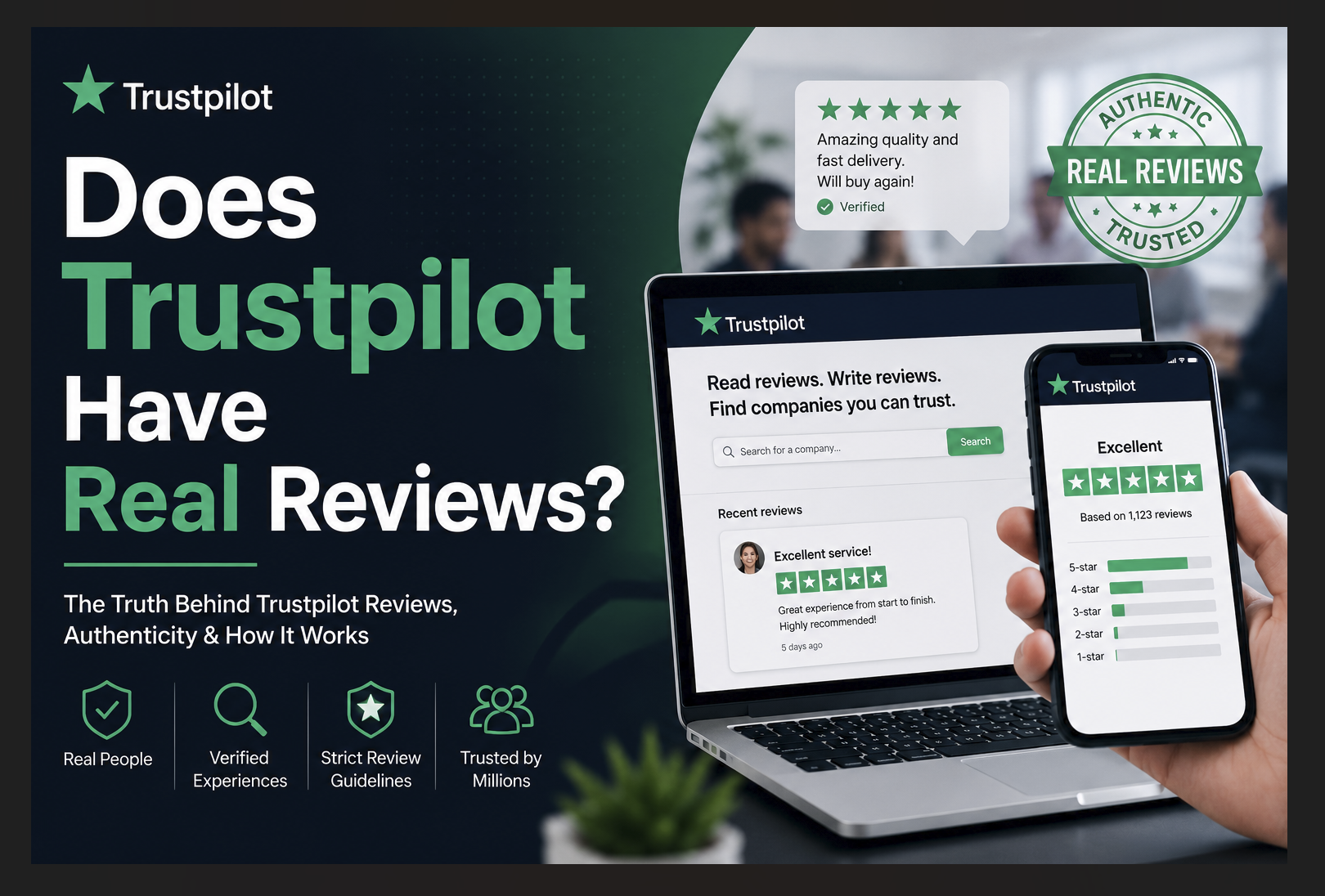
If you’ve ever searched for a company’s reputation online, chances are you’ve come across Trustpilot. Millions of consumers use the platform to read customer experiences before making purchasing decisions. At the same time, businesses proudly display their Trustpilot ratings on their websites and marketing materials.
But one question continues to appear in Google searches:
Does Trustpilot have real reviews?
The short answer is yes—but not every review is guaranteed to be genuine.
Like every large review platform, Trustpilot receives millions of user-generated reviews. While the majority are written by real customers sharing authentic experiences, the platform also faces attempts by some individuals and businesses to publish fake, misleading, or manipulated reviews. This is why Trustpilot has invested heavily in automated fraud detection systems, reporting tools, and moderation processes.
Understanding how the platform works helps consumers make better purchasing decisions and helps businesses build trust ethically.
In this guide, you’ll learn:
- Whether Trustpilot reviews are real
- How Trustpilot detects fake reviews
- What businesses can and cannot do
- How to spot suspicious reviews
- Whether you should trust Trustpilot ratings when buying products or services
What Is Trustpilot?
Trustpilot is an online customer review platform where people can share their experiences with businesses across thousands of industries, including:
- E-commerce
- SaaS companies
- Local businesses
- Financial services
- Travel
- Healthcare
- Technology
- Education
Customers can leave reviews describing their experience, often accompanied by a star rating ranging from one to five stars.
Businesses can also create profiles, respond publicly to reviews, invite customers to leave feedback, and use Trustpilot as part of their reputation management strategy.
Unlike review sections hosted directly on a company’s website, Trustpilot functions as an independent third-party platform.
Does Trustpilot Have Real Reviews?
Yes, Trustpilot contains many genuine customer reviews written by real people.
However, because anyone can attempt to submit a review, the platform cannot guarantee that every review published is authentic at the moment it appears.
Instead, Trustpilot relies on multiple layers of fraud prevention designed to identify and remove suspicious activity.
This means the platform contains:
- Genuine customer experiences
- Positive reviews
- Negative reviews
- Neutral reviews
- Occasionally fake or misleading reviews that may later be detected and removed
The important point is that Trustpilot actively works to identify policy violations rather than claiming every review is automatically verified before publication.
How Trustpilot Reviews Work
Understanding the review process makes it easier to judge authenticity.
Step 1: A customer has an experience
Someone purchases a product or uses a service.
Step 2: They submit a review
The reviewer leaves:
- Star rating
- Written feedback
- Business name
- Optional photos or supporting information
Step 3: Automated systems analyze the review
Trustpilot uses automated technology to evaluate signals that may indicate suspicious behavior.
Examples include unusual reviewing patterns, repeated activity, or behavior that appears inconsistent with normal customer reviews.
Step 4: Businesses can respond
Businesses may publicly reply to reviews.
Professional responses often increase credibility because they demonstrate transparency.
Step 5: Reviews may be reported
If someone believes a review violates Trustpilot policies, it can be flagged for investigation.
Can Fake Reviews Appear on Trustpilot?
Yes.
No online review platform is completely immune to fake reviews.
This includes platforms such as:
- Google Reviews
- Yelp
- Tripadvisor
- Amazon product reviews
- Facebook recommendations
Fake reviews generally fall into several categories.
Positive fake reviews
Someone attempts to improve a business’s reputation by posting reviews that do not reflect a genuine customer experience.
Negative fake reviews
Competitors or unrelated individuals sometimes attempt to damage a company’s reputation through false negative reviews.
Incentivized reviews
Reviews written because someone received compensation or another benefit without proper disclosure may violate platform policies.
How Trustpilot Detects Fake Reviews
Trustpilot combines automated technology with investigation processes to identify suspicious reviews.
While the company does not publicly disclose every detail of its detection systems, the platform explains that it uses automated fraud detection along with additional review and reporting mechanisms.
These systems may evaluate factors such as:
- Unusual reviewing behavior
- Multiple reviews from related activity
- Patterns inconsistent with genuine customer behavior
- Reports submitted by businesses or users
- Potential policy violations
If a review appears suspicious, Trustpilot may:
- Remove it
- Ask for additional information
- Investigate further
- Take action against accounts violating platform policies
Because fraud techniques constantly evolve, review moderation is an ongoing process rather than a one-time check.
Does Trustpilot Verify Every Purchase?
This is one of the biggest misconceptions.
No, Trustpilot does not verify every purchase before allowing reviews to be published.
Instead, reviews are generally based on customer experiences shared by users.
Some businesses use invitation systems that encourage verified customers to leave reviews after completing a purchase or service. While this can increase confidence that reviewers interacted with the business, it does not mean every review on the platform is purchase-verified.
For that reason, readers should evaluate reviews critically rather than relying on a single rating alone.
Are Negative Reviews Real?
Many people assume negative reviews are fake.
That assumption is often incorrect.
Legitimate businesses naturally receive a mixture of:
- Excellent experiences
- Average experiences
- Poor experiences
A profile containing only perfect five-star reviews may actually appear less natural than one containing a balanced mix of positive and negative feedback.
What matters is how the business responds.
Companies that professionally address complaints often demonstrate stronger customer service than those that ignore criticism altogether.
What Makes a Trustpilot Review More Credible?
Not every review carries the same level of trust.
When evaluating reviews, look for characteristics such as:
Detailed experiences
Authentic reviewers usually describe:
- What they purchased
- What happened
- Timeline of events
- Customer service interaction
- Final outcome
Specific details are generally more useful than vague praise or criticism.
Balanced language
Real customers often mention both positives and negatives.
Example: “Shipping was slower than expected, but customer support resolved the issue quickly.”
Balanced reviews tend to sound more authentic than overly emotional or exaggerated comments.
Consistency
If many unrelated reviewers describe similar strengths or weaknesses, those recurring themes may provide valuable insight into the business.
Signs That a Trustpilot Review May Not Be Genuine
While no single factor proves a review is fake, certain patterns should encourage readers to take a closer look.
1. Extremely Generic Content
Reviews that say only:
- “Excellent!”
- “Amazing service!”
- “Highly recommended.”
without explaining why may be less helpful than detailed reviews.
A genuine customer usually shares specifics such as the product purchased, customer service interaction, delivery experience, or final outcome.
2. Repetitive Language
If multiple reviews use nearly identical wording, sentence structure, or phrases, they may deserve additional scrutiny.
Examples include repeated marketing-style language or reviews that sound like advertisements instead of personal experiences.
3. Sudden Spikes in Reviews
Receiving many reviews within a short period isn’t automatically suspicious.
For example, a business may launch a successful marketing campaign or send review invitations after a large sales event.
However, if dozens of nearly identical five-star reviews appear in a very short timeframe without much variation, it’s worth looking deeper.
4. No Meaningful Details
Authentic reviews often answer questions such as:
- What product or service did they buy?
- When did they interact with the company?
- What problem were they trying to solve?
- How did customer support respond?
The more context a review provides, the easier it is to evaluate.
5. Overly Emotional Language
Reviews filled with exaggerated praise or criticism—but lacking factual information—should be interpreted carefully.
For example:
“Worst company ever!!!”
or
“Absolutely perfect in every possible way!!”
may provide less value than reviews explaining the actual experience.
How Businesses Use Trustpilot
Trustpilot isn’t just for consumers. Many businesses actively use it to understand customer feedback and improve their services.
Common uses include:
- Collecting customer feedback
- Building online reputation
- Identifying service issues
- Responding to customer concerns
- Showcasing customer satisfaction
- Improving products based on reviews
When used ethically, reviews can help businesses learn what they’re doing well and where improvements are needed.
Can Businesses Remove Negative Reviews?
A common misconception is that businesses can simply delete negative reviews they don’t like.
Generally, no.
Businesses cannot remove legitimate negative reviews simply because they are unfavorable.
However, they can report reviews they believe violate Trustpilot’s policies, such as reviews that may include:
- Spam
- Hate speech
- Threats
- Fake customer experiences
- Personal information
- Promotional content unrelated to the customer experience
Trustpilot reviews reported content and decides whether it should remain on the platform based on its policies.
Trustpilot vs Other Review Platforms
Every review platform has strengths and limitations. Rather than relying on a single source, consumers should compare feedback from multiple trusted platforms.
| Feature | Trustpilot | Google Reviews | Yelp |
|---|---|---|---|
| Third-party review platform | ✅ Yes | ✅ Yes | ✅ Yes |
| Business responses | ✅ Yes | ✅ Yes | ✅ Yes |
| Customer star ratings | ✅ Yes | ✅ Yes | ✅ Yes |
| Fraud detection systems | ✅ Yes | ✅ Yes | ✅ Yes |
| Fake reviews possible | Yes | Yes | Yes |
| User reporting system | ✅ Yes | ✅ Yes | ✅ Yes |
Key takeaway: No review platform can guarantee that every published review is genuine. The value comes from combining automated detection, moderation, user reporting, and informed readers who evaluate reviews critically.
Should You Trust a Company’s Overall Rating?
A company’s average star rating is useful—but it shouldn’t be the only factor influencing your decision.
Instead, consider:
- The number of reviews
- The consistency of customer experiences
- Recent reviews
- How the business responds to complaints
- Whether issues appear to be isolated or recurring
For example:
A company with a 4.6-star rating and thoughtful responses to customer concerns may inspire more confidence than a company with a perfect 5-star rating but only a handful of reviews and no engagement.
Best Practices for Reading Trustpilot Reviews
Use this simple checklist before making a purchase.
✅ Read More Than the First Few Reviews
Don’t base your opinion on only the top reviews.
Browse positive, negative, and average ratings to understand the overall customer experience.
✅ Sort by Recent Reviews
Businesses change over time.
Reading the latest reviews gives you a better understanding of the company’s current performance rather than experiences from several years ago.
✅ Look for Recurring Themes
If many independent reviewers mention the same issue, such as delayed shipping or excellent customer support, that pattern may be more meaningful than any single review.
✅ Read Business Responses
Professional responses can reveal a lot about a company’s customer service.
Look for businesses that:
- Acknowledge problems
- Offer solutions
- Remain polite
- Avoid arguing with customers publicly
✅ Compare Multiple Sources
Don’t rely solely on Trustpilot.
Check other sources such as:
- Google Reviews
- Industry forums
- Social media discussions
- Independent review websites
- Consumer communities
Comparing feedback from multiple sources helps you form a more balanced opinion.
Tips for Businesses Using Trustpilot Ethically
Businesses can build long-term credibility by following ethical review practices.
Encourage Honest Feedback
Invite all customers—not just satisfied ones—to leave reviews. A balanced review profile appears more authentic and helps identify areas for improvement.
Never Offer Undisclosed Incentives
Avoid practices that could influence customers to leave only positive reviews. Transparency is essential for maintaining trust.
Respond Professionally
Thank customers for positive feedback and address negative experiences respectfully. Public responses demonstrate accountability and commitment to customer satisfaction.
Learn from Customer Feedback
Use recurring comments to improve products, services, or support processes. Reviews are valuable business insights, not just marketing assets.
Why Balanced Reviews Matter?
From an Experience, Expertise, Authoritativeness, and Trustworthiness (E-E-A-T) perspective, the most reliable businesses don’t necessarily have perfect ratings—they have transparent review histories.
A credible review profile often includes:
- Positive and negative experiences
- Detailed customer stories
- Timely business responses
- Consistent feedback over time
- Ongoing engagement with customers
Consumers should be cautious of businesses with only glowing reviews and no constructive criticism, as a natural review profile typically reflects a range of customer experiences.
Frequently Asked Questions (FAQs)
1. Does Trustpilot have real reviews?
Yes, Trustpilot contains many real customer reviews, but no platform can guarantee that every published review is authentic. Trustpilot uses automated fraud detection, reporting tools, and moderation processes to identify reviews that may violate its policies. As a reader, it’s best to evaluate multiple reviews rather than relying on a single comment.
2. Can fake reviews appear on Trustpilot?
Yes, fake reviews can sometimes appear on Trustpilot. Like other major review platforms, Trustpilot may receive attempts to post misleading or fraudulent reviews. The platform investigates suspicious activity and may remove reviews that breach its guidelines, but no system can prevent every fake review from appearing immediately.
3. Does Trustpilot verify every customer purchase?
No, Trustpilot does not verify every purchase before a review is published. Some businesses invite verified customers to leave reviews after completing a purchase, but not all reviews are tied to a purchase verification process. This is why readers should consider the overall review profile rather than a single review.
4. How can I tell if a Trustpilot review is genuine?
Look for reviews that include specific details and balanced experiences. Genuine reviews often explain what the customer purchased, what went well or poorly, and how the business responded. Reading multiple recent reviews and looking for recurring themes can also help you judge credibility.
5. Can businesses delete negative Trustpilot reviews?
No, businesses cannot simply remove genuine negative reviews. They can report reviews they believe violate Trustpilot’s policies, such as spam, abusive content, or reviews that appear fraudulent. Trustpilot reviews the reported content and decides whether it should remain on the platform.
6. Should I rely only on Trustpilot before buying from a business?
No. Trustpilot should be one part of your research. For the most informed decision, compare reviews across several reputable platforms, visit the company’s official website, check recent customer feedback, and consider independent discussions in forums or social media communities.
Key Takeaways
If you only remember a few things from this guide, make them these:
- Yes, Trustpilot hosts many genuine customer reviews.
- No review platform is completely free from fake or misleading reviews.
- Trustpilot uses automated technology, moderation, and community reporting to detect policy violations.
- Businesses cannot simply delete legitimate negative reviews.
- Reading multiple detailed, recent reviews provides a more accurate picture than relying on a single rating.
- Comparing Trustpilot with other trusted sources helps you make better purchasing decisions.
Final Verdict: Does Trustpilot Have Real Reviews?
Yes—Trustpilot has many real reviews, but it is not perfect.
As one of the world’s largest online review platforms, Trustpilot provides a valuable space for customers to share their experiences and for businesses to engage with feedback. While fraudulent reviews can occasionally appear, the platform has systems designed to detect and address suspicious activity.
The smartest approach is to treat Trustpilot as one source of information rather than the only source. Read reviews carefully, look for consistent patterns, evaluate how businesses respond to criticism, and compare feedback across multiple platforms before making important purchasing decisions.
For businesses, the best long-term strategy is simple: earn authentic customer reviews through excellent products, reliable service, and transparent communication. Genuine customer experiences build lasting trust far more effectively than attempting to manipulate online ratings.